Compare
April 6, 2026
AnyCap vs
OpenAI Agent
Builder
AnyCap vs OpenAI Agent Builder is not a same-category comparison, even though both appear in agent infrastructure decisions. OpenAI Agent Builder is a workflow-authoring layer for designing, testing, versioning, and deploying multi-step systems directly on the OpenAI stack, including node-level control flow and ChatKit deployment paths. AnyCap is a capability runtime layer for agents you already use across developer environments. Instead of designing workflow graphs, it standardizes execution access to image, video, vision, search, storage, and publishing through one CLI and one auth flow. The key architecture question is whether your team needs to design and ship an OpenAI-native workflow product, or equip existing agents with broader capabilities while preserving portability across shells. Getting this distinction wrong usually causes teams to overbuild in one layer and underinvest in the other. Clear layer boundaries make procurement and implementation decisions significantly cleaner.
Answer-first summary
Choose OpenAI Agent Builder when your priority is to visually design, test, version, and deploy an OpenAI-native workflow, especially if the output becomes an embedded chat or product-facing experience. Choose AnyCap when your team already has agents such as Codex, Cursor, Claude Code, or OpenClaw and needs those agents to gain multimodal execution through one shared runtime. In that scenario, one runtime usually outperforms repeated capability wiring projects because install, auth, and operational behavior stay consistent across environments. The practical split is clear: workflow-authoring and deployment lifecycle points to Agent Builder; cross-agent capability execution points to AnyCap. Architecture reviews are faster when these two responsibilities are evaluated separately, then scored against expected maintenance burden after launch, governance constraints, and portability requirements across future agent environments. It also reduces category confusion during procurement and rollout planning.
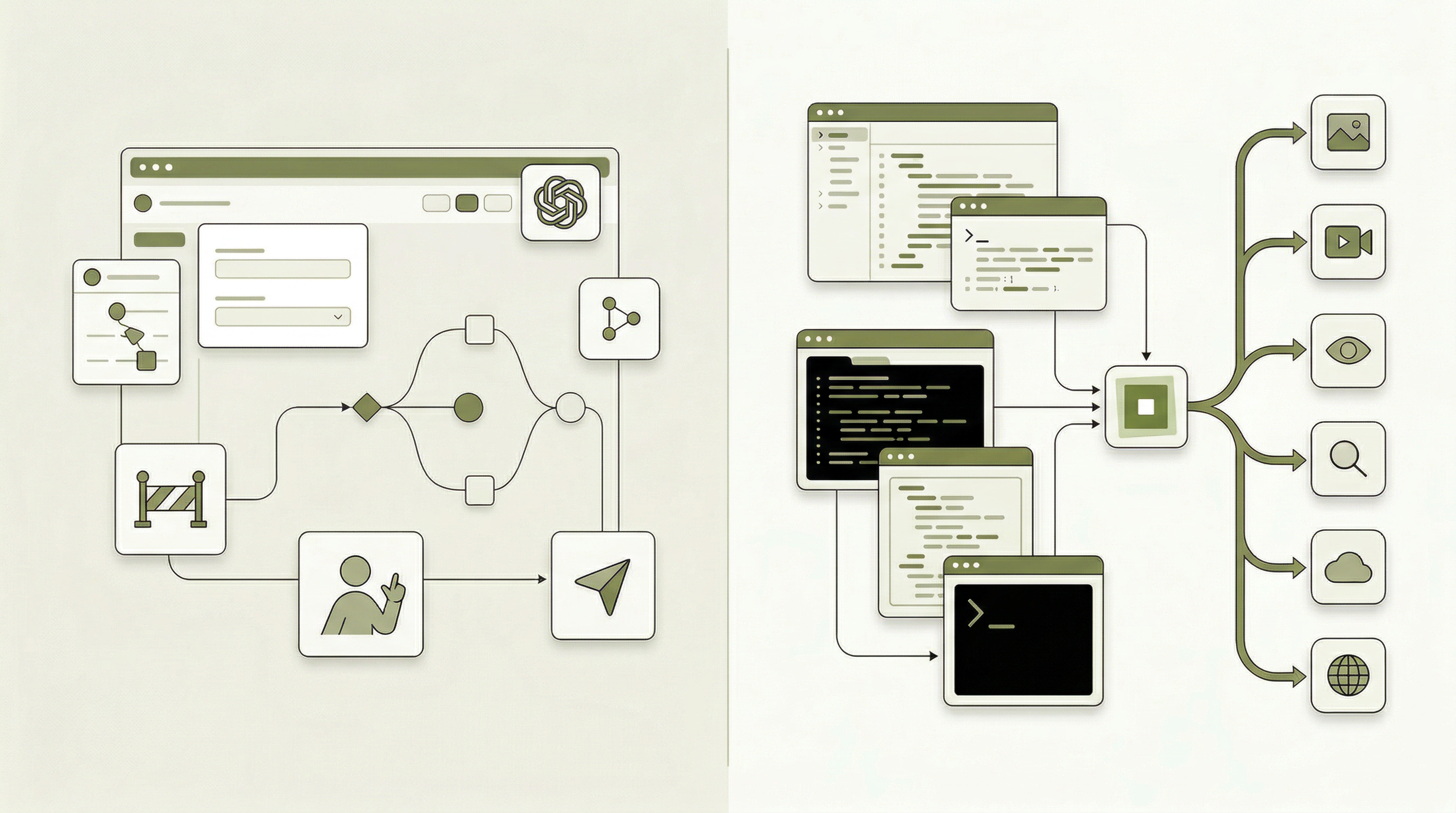
This hero image was generated with AnyCap using Nano Banana 2. The left side represents the workflow-builder layer, and the right side represents a shared capability runtime that multiple coding agents can plug into during execution.
Side-by-side comparison
| Dimension | AnyCap | OpenAI Agent Builder |
|---|---|---|
| Primary job | Agent-native capability runtime that existing agents call during execution. | Visual workflow builder for designing, previewing, versioning, and deploying OpenAI-based agent workflows. |
| Best fit | Teams already using Codex, Cursor, Claude Code, OpenCode, OpenClaw, or custom harnesses that need one shared capability layer. | Teams building customer-facing or internal agent workflows directly on the OpenAI platform. |
| Workflow model | One CLI and one auth flow focused on capabilities such as image, video, vision, search, storage, and publishing. | A node-based canvas with agents, tools, logic, state, typed edges, and preview runs. |
| Deployment path | Install once, log in once, and reuse the same runtime from multiple agent shells. | Publish workflow versions, then embed with ChatKit or export workflow code for an Agents SDK integration. |
| Tooling scope | Curated capability layer with one credential and one command surface. | Compose agent nodes with file search, guardrails, MCP, human approval, and control-flow logic. |
| Vendor alignment | Designed to travel across agent environments instead of anchoring the team to one builder UI. | Strongest when the workflow, model, and deployment path stay inside the OpenAI stack. |
| Output handling | Pairs execution with Drive storage and web publishing so artifacts can be kept, shared, and reused. | Focuses on workflow orchestration and app deployment rather than a cross-agent capability runtime. |
| Decision lens | Choose when the question is: how do my existing agents gain capabilities? | Choose when the question is: how do I design and ship an OpenAI agent workflow? |
Comparison reviewed against public OpenAI docs and published AnyCap pages on April 6, 2026.
The real framing: workflow builder vs capability runtime
Teams often compare these products because both appear in conversations about agent infrastructure. But they solve different problems. Agent Builder decides how an OpenAI workflow is assembled, routed, reviewed, versioned, and deployed. AnyCap decides how an agent gets capabilities once the agent or harness is already in place.
That difference matters because it changes the buying question. If you are choosing a builder, you are choosing how the workflow itself will be authored and shipped. If you are choosing AnyCap, you are choosing whether to standardize the execution layer that multiple agents can share.
Do you need to design the workflow?
Ask this first
If yes, OpenAI Agent Builder is the more relevant product because the visual workflow, node contracts, approvals, and deployment path are the center of the job to be done.
Or do you need to equip existing agents?
Ask this next
If the agent shell is already decided and the problem is missing capabilities, AnyCap is the better comparison because it standardizes capability access across existing agent environments.
Builder on one side, runtime on the other
Practical rule
This page is strongest when you read it as an architecture comparison rather than a feature checklist. The categories are adjacent, not interchangeable.
Where OpenAI Agent Builder is strong
- OpenAI describes Agent Builder as a visual canvas for multi-step workflows, so it is the better fit when the workflow itself is what you are designing.
- The node system covers agent nodes, file search, guardrails, MCP, logic, human approval, and state management in one place.
- Published workflows become versioned objects, which is helpful when the team needs stable releases and rollback points.
- There is a direct path into ChatKit, which OpenAI positions as the recommended way to embed agentic chat experiences.
Where AnyCap is the better fit
- AnyCap is the better fit when the agent shell is already chosen and the missing layer is capability access rather than workflow design.
- One CLI and one auth flow can travel across Codex, Cursor, Claude Code, OpenClaw, and similar environments without rebuilding the stack each time.
- The product is optimized around capability access such as image generation, video generation, image understanding, search, Drive storage, and publishing.
- This makes AnyCap more useful for teams that operate across several agent products and want one runtime surface instead of one builder per vendor.
Best fit by use case
Choose OpenAI Agent Builder if
The workflow itself is the product.
You need to map multi-step behavior visually, test nodes with live data, add guardrails and approvals, then publish versions for a deployed chat or app flow.
Choose AnyCap if
The agent is already chosen and the missing layer is capability access.
You want Codex, Cursor, Claude Code, OpenClaw, or a custom harness to gain image, video, vision, search, storage, and publishing through one shared runtime.
Choose OpenAI Agent Builder if
You want a tight OpenAI-stack deployment path.
Agent Builder is a stronger match when you want versions, OpenAI-hosted workflow execution, and a direct ChatKit path into an embedded customer-facing chat experience.
Choose AnyCap if
You care more about portability than builder UX.
AnyCap is stronger when the same capability surface needs to move with the team across multiple agent shells rather than being attached to one workflow canvas.
How this comparison was reviewed
The OpenAI side of this page was reviewed against official OpenAI developer docs available on April 6, 2026. The core claims used here are intentionally narrow and verifiable: Agent Builder is a visual canvas for multi-step workflows; it supports typed inputs and outputs, preview runs, templates, versioned publishing, and deployment through ChatKit or exported workflow code; its node system covers agents, file search, guardrails, MCP, logic, human approval, and state.
The AnyCap side of the comparison is based on published AnyCap pages for the CLI, installation flow, capability-runtime definition, Drive, and pricing. Claims are limited to what those pages already state publicly: one CLI, one auth flow, cross-agent fit, shared capability access, storage, public URLs, and web publishing support.
Methodology note
This page compares layer fit, not which company has more total product surface area. If OpenAI changes Agent Builder deployment options or AnyCap changes its capability inventory later, the page should be updated to stay tied to current public documentation.
Source notes
Visual canvas, typed inputs and outputs, templates, preview, workflow publishing, ChatKit, and exported code.
Agent, file search, guardrails, MCP, logic, human approval, transform, and state nodes.
Prompt injection, data leakage, structured outputs, tool approvals, and guardrails guidance.
One CLI, one auth flow, and one capability surface across multiple agent environments.
Published setup flow for Codex, Cursor, OpenClaw, and similar agent products.
Definition of the category AnyCap is trying to own.
Shared storage and public URLs for outputs that need to survive beyond one run.
Related pages
Glossary
Agent Capability Runtime
Read the core definition for the category AnyCap is trying to own.
Product
AnyCap CLI
See the one-command surface that lets capabilities travel across agent environments.
Agent fit
AnyCap for Codex
See what it looks like when the agent is already chosen and the missing layer is capability access.
Compare
AnyCap vs Composio
Compare a capability runtime with a broader tool-integration platform.
FAQ
Is AnyCap an agent builder?
No. AnyCap is an agent-native capability runtime, not a visual workflow builder. It equips existing agents with a shared execution layer for image, video, vision, search, storage, and publishing, while leaving workflow-authoring concerns to whatever orchestration layer you already use. Teams adopt it when they need execution portability and faster capability rollout, not when they need to design node graphs.
Is OpenAI Agent Builder better for customer-facing agent apps?
Usually yes. OpenAI positions Agent Builder around visually designing workflows, publishing versioned builds, and deploying them with ChatKit or exported workflow code. That model is a strong fit when the workflow itself is part of the product experience and needs release management. In those cases, builder ergonomics, version controls, and deployment paths matter more than cross-shell runtime portability.
When should a team compare AnyCap to OpenAI Agent Builder?
Compare them when the team is deciding between two adjacent stack layers: a workflow builder on the OpenAI platform versus a shared runtime that equips already-chosen agents during execution. If architecture discussions keep mixing workflow design needs with capability access needs, this comparison helps separate those concerns. The right choice usually becomes obvious once the team defines where orchestration ends and capability execution begins.
Can AnyCap replace OpenAI Agent Builder?
Not when you specifically need a visual workflow canvas, node-level control flow, versioned workflow publishing, or ChatKit deployment. AnyCap replaces capability wiring work, not the workflow-builder category itself. It can complement a builder strategy by simplifying execution capabilities, but it does not replace builder-native design and release semantics.
What is the simplest rule of thumb?
If you need to design and ship an OpenAI-native workflow, choose Agent Builder. If you already have agents and need them to execute more capabilities across environments, choose AnyCap. When teams are undecided, mapping whether the primary deliverable is a workflow product or a portable execution layer typically resolves the decision quickly.